
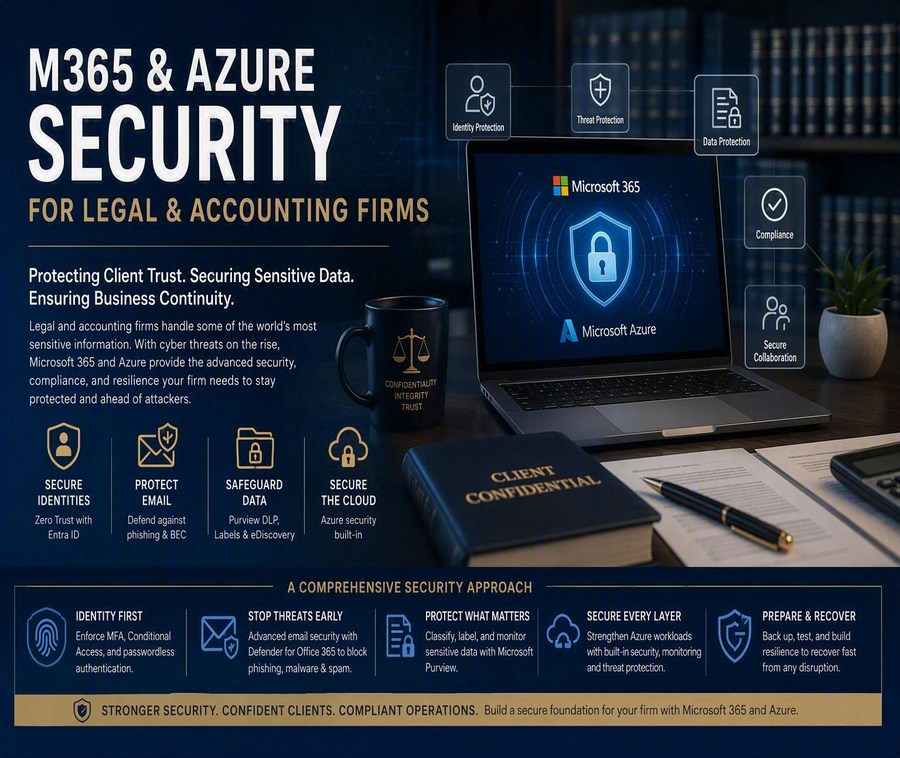
Protecting Client Trust, Sensitive Data, and Business Operations in a Modern Threat Landscape
In today’s digital-first environment, legal and accounting firms face a unique challenge. Clients expect seamless collaboration, remote access, cloud-based document management, and rapid service delivery, while simultaneously demanding the highest levels of confidentiality and data protection. As cybercriminals become increasingly sophisticated, professional services firms are finding themselves directly in the crosshairs of ransomware groups, phishing campaigns, and business email compromise attacks.
The reality is simple: legal and accounting firms store some of the most valuable information a cybercriminal can access. From financial statements and tax records to merger documentation, litigation files, payroll information, and highly confidential client correspondence, the modern firm has become a treasure trove of sensitive data. Industry reporting continues to show that law firms and financial organizations remain high-value targets due to the nature of the information they hold and the trust-based relationships they maintain with clients.
Microsoft 365 and Azure provide a comprehensive security ecosystem designed to help firms protect sensitive information, meet compliance obligations, and respond quickly to emerging threats. However, simply purchasing licenses is not enough. The organizations achieving the highest levels of security are those that properly configure, monitor, and continuously improve their Microsoft security posture.
The Growing Cybersecurity Threat Facing Professional Services Firms
Cybersecurity is no longer just an IT department concern. It has become a business continuity, compliance, and reputational issue.
Legal and accounting firms are increasingly targeted because attackers know the information they hold has significant financial value. A successful attack may provide access to client banking information, trust account details, commercial contracts, tax returns, intellectual property, acquisition plans, or confidential legal advice. In many cases, a single compromised account can expose thousands of sensitive client files.
Recent threat intelligence has highlighted sophisticated attacker groups targeting financial institutions, private equity firms, law firms, and professional services organizations using advanced social engineering techniques. Many of these attacks focus specifically on Microsoft 365 environments because email, collaboration, document storage, and identity management are centralized within the platform.
For legal and accounting firms, the consequences of a successful breach often extend beyond financial loss. Organizations may face:
Regulatory investigations
Privacy breaches
Loss of client trust
Operational disruption
Insurance implications
Legal liability
Reputational damage
Contractual penalties
The cost of recovering from an incident often far exceeds the investment required to implement preventative security controls.
Why Microsoft 365 Has Become the Primary Security Battleground
Most modern firms now operate almost entirely within Microsoft 365.
Daily business functions rely on:
Exchange Online for email
Microsoft Teams for communication
SharePoint Online for document management
OneDrive for file storage
Microsoft Entra ID for identity management
Microsoft Defender for security protection
Microsoft Purview for compliance and governance
While this centralized platform offers tremendous productivity benefits, it also means attackers frequently focus their efforts on gaining access to a single Microsoft 365 identity. Once compromised, an attacker may gain visibility across the firm’s entire digital environment.
The positive news is that Microsoft has invested heavily in security capabilities designed to prevent, detect, and respond to these threats. When properly configured, the Microsoft security stack provides multiple layers of protection that work together to minimize risk and limit the impact of successful attacks.
Identity Security: The Foundation of Modern Protection
Every cybersecurity strategy should begin with identity protection.
Research consistently shows that compromised credentials remain one of the most common entry points used by attackers. Password theft, phishing campaigns, credential stuffing attacks, and social engineering techniques continue to target employees at every level of an organization.
Microsoft Entra ID provides a powerful identity security platform that allows firms to implement modern Zero Trust principles.
Key security controls include:
Multi-Factor Authentication (MFA)
MFA remains one of the most effective security controls available and significantly reduces the risk of automated account compromise. However, firms should not rely solely on traditional MFA implementations. Modern attackers increasingly attempt to bypass authentication through token theft and advanced phishing techniques.
Conditional Access
Conditional Access policies allow firms to evaluate risk before granting access to systems and data.
Examples include:
Blocking sign-ins from high-risk countries
Restricting unmanaged devices
Requiring compliant devices
Enforcing stronger authentication for sensitive applications
Preventing access from anonymous networks
Passwordless Authentication
Organizations are increasingly adopting passwordless technologies such as:
Windows Hello for Business
FIDO2 Security Keys
Passkeys
These technologies reduce the likelihood of credential theft while improving user experience.
Defending Against Advanced Email Threats
Email remains the most common attack vector used by cybercriminals.
Professional services firms are particularly attractive targets because financial transactions, settlement instructions, invoice approvals, and client communications frequently occur through email. Attackers understand this and often focus on business email compromise campaigns designed to intercept or redirect payments.
Microsoft Defender for Office 365 provides advanced protection capabilities including:
Safe Links
Safe Attachments
Anti-phishing protection
Impersonation detection
Threat intelligence
Automated investigation and response
These technologies help prevent malicious emails from reaching users while providing security teams with visibility into emerging threats.
Professional services firms should also implement:
SPF records
DKIM signing
DMARC policies
These controls help reduce email spoofing and improve trust in business communications.
Protecting Sensitive Client Information with Microsoft Purview
Protecting Sensitive Client Information with Microsoft Purview
For legal and accounting firms, data protection and compliance are often equally important.
Firms must protect confidential information while meeting industry regulations, legal obligations, and client contractual requirements.
Microsoft Purview provides a comprehensive suite of information protection and governance capabilities that help organizations maintain control over their data regardless of where it resides.
Data Loss Prevention (DLP)
DLP policies help prevent unauthorized sharing of:
Tax identification numbers
Financial account details
Client records
Credit card information
Legal documentation
Confidential financial reports
Sensitivity Labels
Sensitivity labels provide a simple but powerful way to classify and protect information.
For example:
Public
Internal
Confidential
Legal Confidential
Client Confidential
Financial Restricted
Labels can automatically apply encryption, restrict sharing, and enforce access controls throughout Microsoft 365.
eDiscovery and Legal Hold
Legal practices must often preserve and retrieve information quickly.
Microsoft Purview eDiscovery helps organizations:
Identify relevant data
Preserve records
Conduct investigations
Respond to legal requests
Support litigation processes
These capabilities are increasingly important as regulatory scrutiny and legal discovery requirements continue to evolve.
Securing Azure Workloads and Business Applications
Many firms now operate critical applications and infrastructure within Microsoft Azure.
These may include:
- Practice management systems
- Client portals
- Virtual desktops
- Database servers
- Financial applications
- Document management platforms
Protecting these workloads requires an ongoing security strategy rather than a one-time deployment exercise.
Microsoft Defender for Cloud helps organizations continuously assess their Azure environment by identifying vulnerabilities, configuration weaknesses, and potential attack paths. Azure-native security tools provide recommendations and alerts that help firms improve their overall security posture.
Additional Azure security best practices include:
- Network segmentation
- Least privilege access
- Azure Key Vault deployment
- Security monitoring
- Immutable storage
- Regular backup testing
- Workload hardening
These controls help reduce risk while supporting operational resilience.
Building Resilience Against Ransomware
Ransomware remains one of the most damaging cyber threats facing organizations today.
Microsoft continues to report significant growth in ransomware sophistication, automation, and attacker capabilities. Modern ransomware groups are increasingly focused on data theft, extortion, and business disruption rather than simple file encryption.
An effective ransomware defence strategy should include:
Prevention
Multi-Factor Authentication
Conditional Access
Endpoint Protection
Security Awareness Training
Attack Surface Reduction Rules
Detection
Microsoft Defender XDR
Microsoft Sentinel
Security Monitoring
Threat Intelligence Correlation
Recovery
Microsoft 365 Backup
Azure Backup
Immutable Backup Storage
Incident Response Planning
Regular Recovery Testing
Microsoft emphasizes that organizations combining prevention, detection, and recovery controls are significantly better positioned to withstand ransomware attacks and recover quickly if an incident occurs.
Measuring Security Success
Implementing security controls is only the beginning.
Successful firms continuously assess their security maturity using tools such as:
Microsoft Secure Score
Secure Score provides organizations with visibility into their overall security posture and offers prioritized recommendations to reduce risk. Organizations can track improvements over time and benchmark themselves against industry peers.
Microsoft Compliance Manager
Compliance Manager helps organizations understand their compliance posture while providing actionable recommendations aligned to industry frameworks and regulatory requirements.
Final Thoughts
For legal and accounting firms, cybersecurity has become a critical business function rather than simply a technology requirement. Clients expect their confidential information to be protected, regulators expect compliance obligations to be met, and business leaders expect uninterrupted operations.
Microsoft 365 and Azure provide one of the most comprehensive security ecosystems available today, combining identity protection, email security, endpoint defence, compliance controls, cloud security, threat detection, and recovery capabilities within a unified platform. When properly implemented and continuously monitored, these technologies help firms reduce risk, strengthen client trust, support regulatory compliance, and build resilience against an increasingly sophisticated threat landscape.
In an industry built on confidentiality, professionalism, and trust, investing in security is no longer optional. It is a fundamental requirement for protecting clients, safeguarding reputation, and ensuring long-term business success.